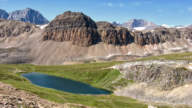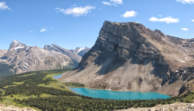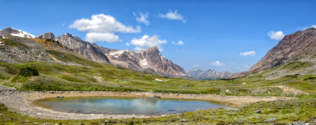
Jonas Pass, Jasper National Park
"The new camp, July 30th, lay near timber line on the south side of the Calumet Valley, about a mile from the [Moose] Pass. It was decidedly the most beautiful camp of the expedition, 6,170 feet by the aneroid. Far below, a gravel flat, cleft by many a silver stream, shows the road to the Big Smoky flowing north. All around are green slopes rising upward, dotted for a short distance only with open spruce, for we were almost at timber line. Behind, the peaks tower like great sloping slabs and in front are rock monsters rising in castellated form, their tiers and terraces marked by snow on the ledges. The spruce are those picturesque trees found at the edge of the alps, each of which constitutes a home in its umbrella security against inclement weather. It was one of the camps that are a joy to all who delight in Nature; where the greens are brighter than ever before, where rare and beautiful flowers form a many-hued and much-patterned carpet and heath and heather grow in your tent. Here you sleep on balsam brush that outrivals the best of mattresses and has a fragrance and aroma only had at tree-line. In the mountains everything is the best or worst and this would have been a paradise but for the mosquitoes, which ceased not day or night. The sun on the snow, the gleam of the ice, the rush of the torrent, the smell of the balsam, the precipices, the waterfalls, the roar of the avalanche infect the blood and carry you back sub-consciously to prehistoric days; the days when we lived in the wilds and fastnesses of Nature, eat when hungry, drank when dry, slept when tired, and feared only the wilder and stronger beasts who had a life partnership in them"
Arthur O. Wheeler
Canadian Alpine Journal, vol. 4, 1912, p. 32
"It is inspiring to visit the mountains any day in the year, but especially so in the July or August springtime, when a fresh start is made, and plants, animals, patient glaciers, hustling torrents, roaring rivers, shining lakes are all hard at work rough-hewing or putting finishing touches on an ever new world."
Arthur P. Coleman
The Canadian Rockies: New and Old Trails, 1911. (Google Books).
This site describes some of the trails I've hiked in the Canadian Rockies since 1980. There are already many excellent trail guides in print and online, so the aim here is to provide some directions and impressions that might not be mentioned in the standard references, or are derived from out-of-print or undocumented accounts. Although the emphasis is on the longer backpacking routes, there are descriptions of several half-day, day and short backpacking trips to assist both novice and experienced hikers in planning trips according to their interests and abilities.
If you are planning to visit the Rockies, I suggest that you try to obtain one of these guides or maps. Once you have an idea of where you want to hike, the next step is to contact the relevant park information office or web site to confirm that the area is accessible and, for overnight trips, to inquire about backcountry camping regulations and availability. As these offices sometimes retain dated or incomplete information, accessibility and trail conditions are often more easily and reliably found out by reading online forums such as ClubTread.
A permit for backpacking in any of the national parks, and some of the provincial parks, must be obtained before you start a trip. Depending on the time of year and location, e.g., the Skyline Trail in mid-summer, it may be necessary to reserve a permit several days, if not months, before arriving in the area. However, in many cases it's possible to arrange the permit on the day of departure. Jasper National Park provides a site for viewing campsite availability and making online reservations. There is a similar facility for Kananaskis Country (including Peter Lougheed Provincial Park).